
A Significant Victory for Privacy, Montana LLCs, and Their Managing Members
There is major news for American business owners—and particularly for individuals who own and manage Montana LLCs.
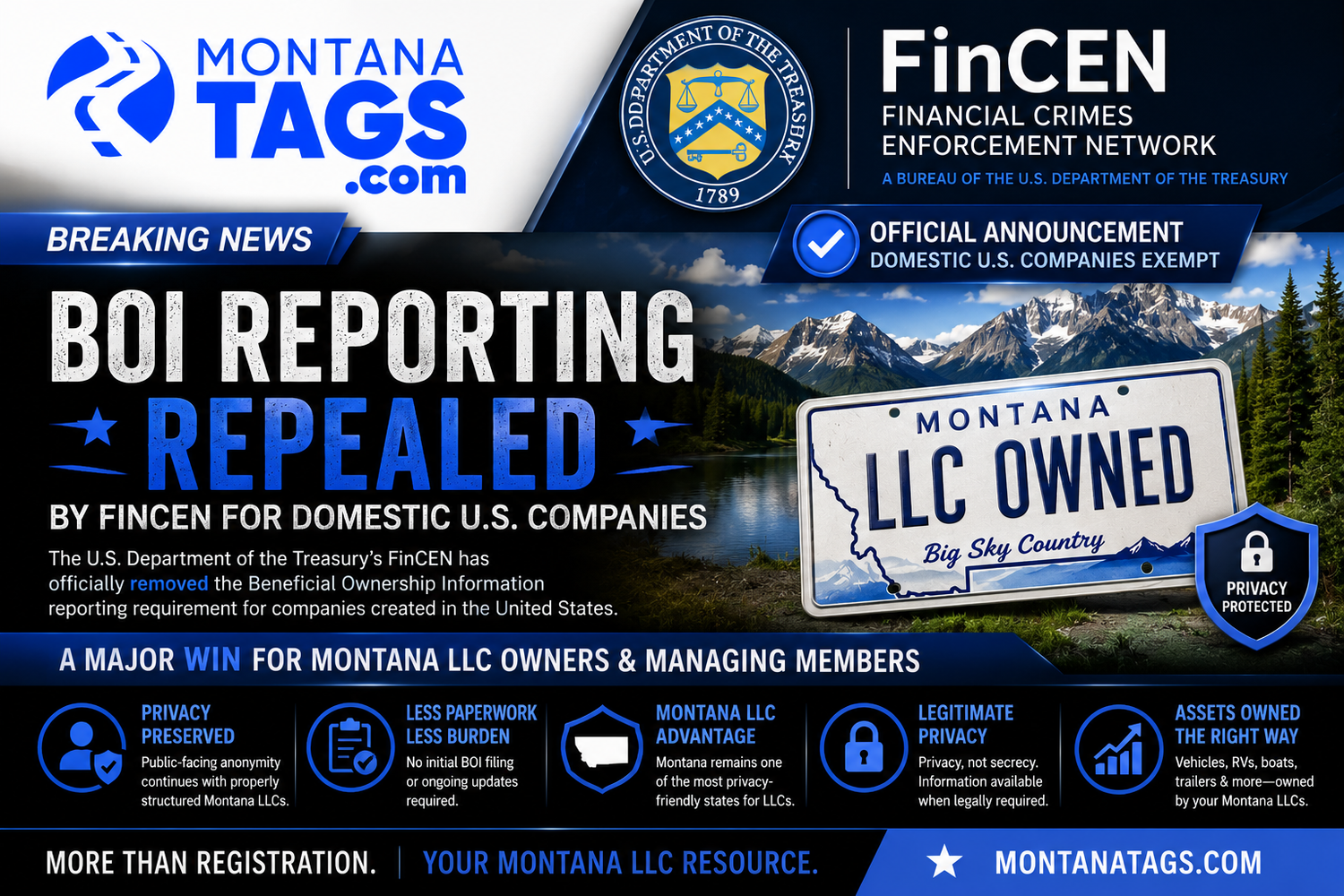
The U.S. Department of the Treasury and its Financial Crimes Enforcement Network (FinCEN) have eliminated the Corporate Transparency Act’s Beneficial Ownership Information reporting requirement for companies created in the United States.
For Montana LLC owners, this is a significant development.
Under the current FinCEN rules, domestic U.S. companies—including Montana LLCs—and their beneficial owners are exempt from the federal BOI reporting requirements.
For individuals who value the legitimate privacy advantages associated with a properly structured Montana LLC, this represents an important victory.
What Was the Beneficial Ownership Information Requirement?
The Corporate Transparency Act created a new federal reporting system requiring millions of American companies to disclose information about the individuals who ultimately owned or controlled them.
This was known as Beneficial Ownership Information, or BOI reporting.
The original regulations generally required covered companies to provide FinCEN with identifying information about their beneficial owners.
Although the FinCEN database was not designed as a public database, the requirement still represented something significant: for the first time, millions of small domestic companies were being required to submit beneficial ownership information to a centralized federal system simply because they operated through corporations or LLCs.
For Montana LLC owners who place a high value on legitimate privacy, this naturally raised concerns.
That federal reporting obligation has now been removed for domestic U.S. companies.
What Changed?
In March 2025, the U.S. Treasury Department announced that it would no longer enforce the Corporate Transparency Act’s BOI reporting requirements against U.S. citizens and domestic reporting companies.
FinCEN subsequently issued an interim final rule narrowing the definition of entities required to report.
The result was substantial:
Companies created in the United States—and their beneficial owners—were exempted from BOI reporting under the Corporate Transparency Act.
The remaining reporting requirements are primarily directed toward certain entities formed under the laws of foreign countries that register to conduct business within the United States.
For the typical Montana LLC created under Montana law, the distinction is extremely important.
This Is a Major Win for Montana LLC Managing Members
One of the reasons Montana LLCs have become so attractive for asset ownership is the privacy that can be achieved through a properly structured company.
The removal of domestic BOI reporting eliminates an additional federal disclosure obligation that many Montana LLC managing members were understandably concerned about.
A Montana LLC can continue to provide legitimate public-facing privacy for its managing members without the LLC’s U.S. beneficial owners being required, solely because of the Corporate Transparency Act, to submit a BOI report to FinCEN.
For existing Montana LLC owners, there is additional good news.
Domestic entities that previously submitted BOI reports are no longer required under the current FinCEN rules to file updated or corrected BOI reports.
For someone forming a new domestic Montana LLC, there is currently no initial BOI filing requirement under the CTA.
That means less paperwork, fewer federal compliance requirements, fewer opportunities for filing mistakes, and greater preservation of the privacy that many individuals seek when establishing a Montana LLC.
Montana LLC Privacy Continues
This development is especially important because privacy is one of the most misunderstood aspects of a Montana LLC.
A properly structured Montana LLC can provide a substantial degree of privacy in ordinary publicly accessible corporate records.
The removal of domestic BOI reporting helps preserve that benefit.
However, it is important to distinguish privacy from invisibility.
A Montana LLC does not—and should never be represented as providing—a way to conceal someone’s identity from law enforcement, courts, taxing authorities, financial institutions, or other entities legally entitled to obtain that information.
Banks can still have customer identification and due-diligence requirements. Courts can issue subpoenas. Government agencies can obtain information when authorized by law. Tax obligations remain tax obligations.
None of that changes.
What does continue is the ability to maintain legitimate privacy from unnecessary public exposure.
There is an enormous difference between keeping someone’s personal information out of an ordinary public business search and attempting to conceal ownership from a government agency with lawful authority to obtain it.
Montana LLC privacy is about legitimate privacy—not evading lawful disclosure requirements.
Why This Matters for Vehicle-Owning Montana LLCs
This is particularly relevant to individuals who establish Montana LLCs to own vehicles and other assets.
Montana LLCs are commonly used to hold automobiles, exotic and collector vehicles, motorcycles, RVs, trailers, boats, recreational vehicles, side-by-sides, and other assets.
When properly structured, the LLC is the legal owner of the asset.
The managing member controls the LLC, but the company and the individual are legally distinct.
The removal of the federal BOI reporting requirement means that establishing a domestic Montana LLC to own an asset does not, by itself, create a CTA obligation requiring the U.S. managing member or beneficial owner to submit beneficial ownership information to FinCEN.
That is a meaningful benefit.
It is equally important to understand what the change does not do.
It does not override another state’s vehicle laws. It does not eliminate insurance requirements. It does not change residency laws, state tax laws, or rules concerning where a vehicle may legally be operated or principally garaged.
Those are separate legal and compliance questions.
The FinCEN change specifically concerns federal Beneficial Ownership Information reporting under the Corporate Transparency Act.
Existing Montana LLC Owners Benefit as Well
This isn’t simply good news for people considering forming Montana LLCs in the future.
It is equally important for individuals who already have Montana LLCs.
Under FinCEN’s current guidance, domestic entities are exempt from BOI reporting, including the obligation to update or correct previously submitted BOI information.
That means an existing Montana LLC managing member does not currently have an ongoing CTA obligation to continually update FinCEN when information changes.
For potentially millions of American business owners, that represents a significant reduction in federal compliance obligations.
Less Federal Reporting. Less Administrative Burden. Greater Privacy.
Whatever one’s opinion of the original Corporate Transparency Act, there is no question that BOI reporting created another layer of compliance for American small businesses.
Deadlines had to be monitored.
Ownership information had to be submitted.
Changes potentially had to be reported.
Business owners had to determine whether their companies were subject to the law or qualified for exemptions.
And mistakes could create concerns about federal penalties.
For domestic Montana LLC owners, that layer of CTA compliance has effectively been removed under the current rules.
For Montana LLC managing members, the benefits are straightforward:
- No initial FinCEN BOI report for domestic Montana LLCs under the current CTA rules.
- No CTA requirement for domestic Montana LLCs to report their U.S. beneficial owners to FinCEN.
- No continuing CTA requirement for domestic entities to update or correct previously submitted BOI reports.
- Less federal paperwork and administrative burden.
- The legitimate public-facing privacy advantages of a properly structured Montana LLC continue.
For Montana LLC owners, that is unquestionably positive news.
Why Your Choice of Montana Registered Agent Matters
This development also highlights something we believe is extremely important.
There is a significant difference between a company that simply processes vehicle-registration paperwork and a Commercial Registered Agent that remains actively involved with its clients and their Montana LLCs.
At MontanaTags.com, our relationship with our clients does not end when a license plate is issued.
We believe that if you establish a Montana LLC, you should understand important developments affecting that company.
That includes changes involving Montana LLC requirements, vehicle registration procedures, federal regulations, beneficial ownership requirements, privacy issues, DMV policies, and other regulatory developments that may directly affect our clients.
The FinCEN BOI change is a perfect example.
Our clients shouldn’t have to discover an important development like this months later through social media or hear about it secondhand.
We want MontanaTags.com clients to know what is changing and, more importantly, understand what those changes actually mean for their LLCs.
MontanaTags.com Is More Than an Administrative Registration Service
There are companies in this industry whose primary function is administrative: receive paperwork, process a registration, issue a plate, and move on to the next transaction.
That’s not the relationship we want with our clients.
MontanaTags.com is a Montana Commercial Registered Agent.
We help establish and maintain Montana LLCs, assist with vehicle registration, and remain a resource for our clients after the original transaction is completed.
When regulations change, we pay attention.
When Montana procedures change, we want our clients to know.
When federal requirements affecting LLC owners change, we want our clients to understand them.
And when a major development strengthens the privacy position of domestic Montana LLC managing members, we believe our clients deserve to hear about it.
That ongoing relationship is an important part of the MontanaTags.com difference.
A Significant Victory for Legitimate Business Privacy
The removal of the Corporate Transparency Act’s BOI reporting requirement for domestic companies represents a major change in federal policy.
For Montana LLC owners and managing members, the result is particularly important.
The federal BOI reporting obligation that created so much uncertainty for domestic LLC owners no longer applies to domestic Montana LLCs under FinCEN’s current rules.
The legitimate privacy advantages associated with Montana LLC ownership continue.
The administrative burden has been reduced.
And domestic Montana LLC owners are no longer required under the current CTA rules to submit beneficial ownership information to FinCEN simply because they own or control their company.
The Bottom Line
This is a win for American small-business owners.
It’s a win for Montana LLCs.
It’s a win for Montana LLC managing members.
And it’s a significant win for legitimate business privacy.
At MontanaTags.com, we will continue doing what we believe a Commercial Registered Agent should do: not simply process paperwork, but keep our clients informed about important developments affecting their Montana LLCs and the assets those companies own.
Because getting your Montana registration completed is only part of what we do.
Keeping you informed, keeping your LLC properly maintained, and being there as the laws and regulations evolve is what separates MontanaTags.com from companies that simply process vehicle registrations.
MontanaTags.com — More Than Registration. Your Montana LLC Resource.
Disclaimer: This article is provided for general informational purposes only and is not intended as legal, tax, or financial advice. Laws, regulations, agency interpretations, and individual circumstances can change. Individuals should consult qualified legal or tax professionals regarding their particular circumstances.