

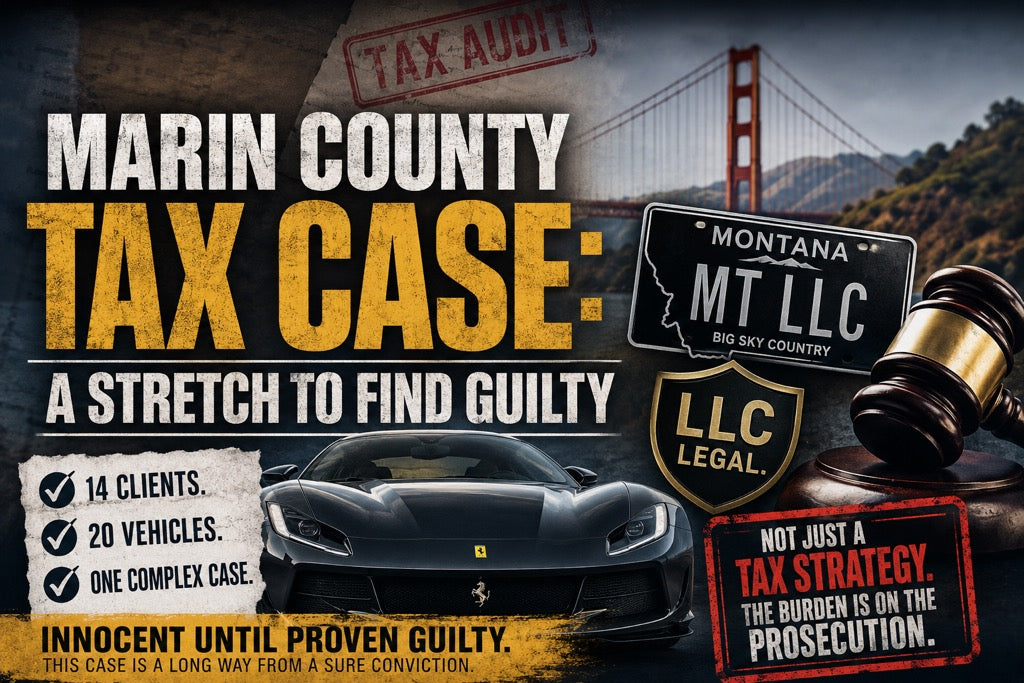
The case involving 14 individuals and approximately 20 luxury vehicle purchases through a Marin County exotic car dealership has generated national attention. California prosecutors have portrayed the matter as a major effort to crack down on what they call the “Montana loophole.” While the allegations are serious, proving criminal guilt beyond a reasonable doubt may be far more difficult than many headlines suggest. (CDTFA)
Criminal Intent Is the Biggest Hurdle
One of the fundamental principles of American criminal law is that prosecutors must prove more than simply a tax deficiency. They must demonstrate that each defendant knowingly and intentionally participated in a fraudulent scheme.
That distinction is critical.
There is an enormous legal difference between:
Structuring a transaction to minimize taxes;
Making a mistake regarding complex tax laws; and
Intentionally submitting false documents or making false statements.
If jurors conclude that a defendant reasonably relied upon attorneys, accountants, registered agents, dealership personnel, or tax professionals who advised that the registration structure was lawful, establishing criminal intent becomes significantly more difficult.
Montana LLCs Are Legal
An often-overlooked fact is that Montana LLCs themselves are completely lawful.
Montana law allows non-residents to form LLCs, and Montana law permits those LLCs to own and register vehicles.
Simply creating a Montana LLC is not illegal.
Simply registering a vehicle in Montana is not illegal.
The legal issue instead becomes whether California can prove that the defendants used otherwise lawful entities as part of an intentional fraud to avoid taxes that California law required them to pay.
That distinction matters because juries generally recognize that lawful business structures cannot automatically become criminal merely because they reduce taxes.
California Must Prove More Than Out-of-State Registration
News reports sometimes leave the impression that Montana plates alone constitute evidence of tax evasion.
They do not.
California must instead prove facts such as:
False statements on government forms;
False bills of lading;
False shipping records;
False declarations regarding where vehicles were delivered;
False representations concerning where the vehicles would principally be used.
Those allegations—not the Montana registration itself—form the basis of the criminal complaint. (CDTFA (https://cdtfa.ca.gov/news/26-02.htm?utm_source=chatgpt.com))
Each Defendant Must Be Judged Individually
Another challenge for prosecutors is that this is not one defendant with one vehicle.
The case involves multiple individuals, multiple vehicles, multiple transactions, dealership personnel, and separate communications spanning several years. (Los Angeles Times (https://www.latimes.com/california/story/2026-04-03/rich-register-ferraris-porsches-in-montana-to-avoid-taxes-california-is-cracking-down?sfmc_id=6529c7f83ed79c24f882d18e&skey_id=020803b0fbae99492bd997d5a432bfbb953f4c1ed25873ece8e88da97290597f&utm_source=chatgpt.com))
Each defendant is entitled to an individual determination of guilt.
Evidence against one purchaser cannot automatically establish guilt for another purchaser.
Likewise, alleged misconduct by dealership employees does not necessarily prove that every customer knowingly participated in a conspiracy.
Reliance on Professionals Can Create Reasonable Doubt
Many luxury vehicle purchasers do not prepare their own paperwork.
Instead, transactions often involve:
Dealership finance managers;
Attorneys;
Accountants;
Registered agents;
Title clerks;
Registration companies.
If purchasers reasonably believed these professionals were handling the transaction legally, a jury may question whether those purchasers possessed the criminal intent necessary for conviction.
Reliance on professional advice is not an automatic defense, but it can create reasonable doubt regarding willfulness.
Tax Avoidance Is Not Automatically Tax Evasion
American law has long recognized the distinction between legally minimizing taxes and illegally evading them.
Courts have repeatedly acknowledged that taxpayers generally have the right to arrange their affairs in a manner that minimizes taxes, provided they comply with applicable law.
The central question therefore becomes whether prosecutors can prove the defendants crossed the line from lawful tax planning into intentional fraud.
The Burden of Proof Is Extremely High
Because these are criminal charges, California bears one of the highest burdens known to law.
The prosecution must establish guilt beyond a reasonable doubt.
That is a much higher standard than the “more likely than not” standard used in civil tax disputes.
Even if California ultimately proves taxes were owed, that alone does not necessarily establish criminal guilt.
This Case Is About Alleged Fraud—Not Montana Law
Perhaps the most important takeaway is that this prosecution is not an attack on Montana law itself.
Montana continues to legally permit:
Non-resident LLC formation;
Vehicle ownership by LLCs;
Registration of vehicles owned by those LLCs.
California’s allegations instead focus on whether certain individuals intentionally misrepresented facts surrounding the purchase, delivery, storage, or use of specific vehicles in order to avoid California tax obligations. (CDTFA (https://cdtfa.ca.gov/news/26-02.htm?utm_source=chatgpt.com))
Conclusion
The Marin County luxury vehicle prosecution is undoubtedly one of California’s most aggressive tax enforcement actions to date. However, despite the publicity surrounding the case, criminal convictions are far from guaranteed.
To prevail, prosecutors must convince a jury that each individual defendant knowingly participated in an intentional scheme to defraud California—not merely that they purchased a vehicle through a Montana LLC or sought to reduce taxes.
Whether California can prove that level of criminal intent for every defendant remains to be seen. As with any criminal prosecution, every defendant is presumed innocent unless and until guilt is proven beyond a reasonable doubt in court.Marin Couty, CA Tax Case: