

The Record Sale
On the night of August 15, during Monterey Car Week, RM Sotheby's sold "Chassis 0" — the first production example of the Ferrari Luce, Ferrari's first fully electric car — for $40 million. The pre-sale estimate had been just over $1.1 million, meaning the final price landed at roughly 36 times what auction house experts expected.
The car itself is a one-off. Built through Ferrari's Tailor Made personalization program, it wears a custom "Madreperla Semi-Gloss" finish that shifts from green to violet in changing light, paired with Le Mans metallic leather interior trim in Perla with Grigio Corvara accents. As chassis number zero, it's also the first production Ferrari ever built without a combustion engine — a historical marker independent of how the Luce itself is ultimately received by collectors.
Every dollar of the sale is going to the Ferrari Foundation, a 501(c)(3) public charity that funds educational programs, and RM Sotheby's waived its buyer's premium on the lot. The result surpasses the $38.5 million paid earlier this year for a 1962 Ferrari 250 GTO and edges out the $38.4 million McLaren F1 GTR sold at the same Monterey sale, making the Luce the most expensive new car ever sold at public auction. The car returns to Maranello for final assembly before delivery in the first quarter of 2027.
What a Sale Like This Raises: The Sales Tax Question
Whoever ends up as the registered owner of a $40 million vehicle faces a genuinely enormous tax exposure if the purchase is treated as an ordinary taxable retail sale in a high-tax state. California, for example, has a base state sales tax of 7.25%, but local district taxes push the combined rate as high as 10.25% in parts of the state. On a $40 million vehicle, that range works out to:
- 7.25% (state minimum): ~$2.9 million
- 10.25% (highest combined CA rate): ~$4.1 million
To be clear: nothing has been publicly reported about who purchased Chassis 0, what state they live in, or how the car will be titled — and because this was a charity auction with proceeds going to a nonprofit, whether ordinary retail sales tax even applies the same way to this specific transaction is a separate legal question. The $2.9–4.1 million range above is illustrative, not a reported fact about this sale. It shows the scale of tax exposure a hypothetical buyer in a high-tax state would face on a purchase this size — which is exactly the exposure that drives collectors of exotic cars, RVs, and yachts toward alternative registration strategies.
The Montana LLC Strategy
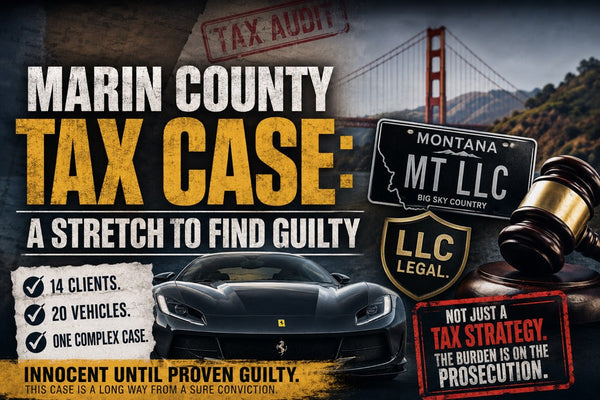
One such strategy, used for decades by owners of exotic cars, motorhomes, and boats, is registering the vehicle under a Montana-formed LLC rather than in the buyer's home state. Montana:
- Has no statewide sales tax
- Doesn't require LLC members to live in Montana
- Has no vehicle emissions testing or safety inspections
- Offers permanent registration for many vehicle types
Because the LLC — not the individual — legally owns the vehicle, and Montana charges no sales tax at titling, buyers can avoid the sales tax bill they'd otherwise owe in their home state. Companies like MontanaTags.com handle the LLC formation and registration paperwork for a flat fee, typically in the $900–1,500 range depending on the vehicle package.
This is a real, legal strategy — with real caveats:
- It has to be a genuine business entity. An LLC formed purely as a tax dodge, with no legitimate business purpose, can be challenged. Several states have pursued residents who garage and drive Montana-plated vehicles locally, treating it as unpaid use tax, sometimes with penalties and interest attached.
- Home-state use tax may still apply. Many states impose a "use tax" on vehicles brought in and regularly used there, regardless of where they're registered — so the savings aren't automatically guaranteed just because the plate says Montana.
- Financing and insurance can get complicated, since lenders and insurers need to underwrite a vehicle titled to an LLC rather than a person.
- Scrutiny has increased. This has been a well-known loophole for over 20 years, and several high-tax states (California among them) have specifically targeted Montana-registered exotics for audits.
The Bottom Line
The Luce's $40 million result is a genuine auction record, driven by its historical significance and charitable framing as much as by the car itself. Separately, Montana LLC registration remains a legitimate option for buyers of expensive vehicles looking to avoid steep home-state sales tax — but it works best as a properly structured business arrangement, not a shortcut, and carries real legal exposure if treated carelessly. Anyone considering it for a purchase of this size should talk to a tax attorney familiar with their home state's use-tax enforcement before assuming the full "sales tax avoided" figure as guaranteed savings.