
🚨 PUBLIC SAFETY OR PUBLIC CONFUSION? 🚨
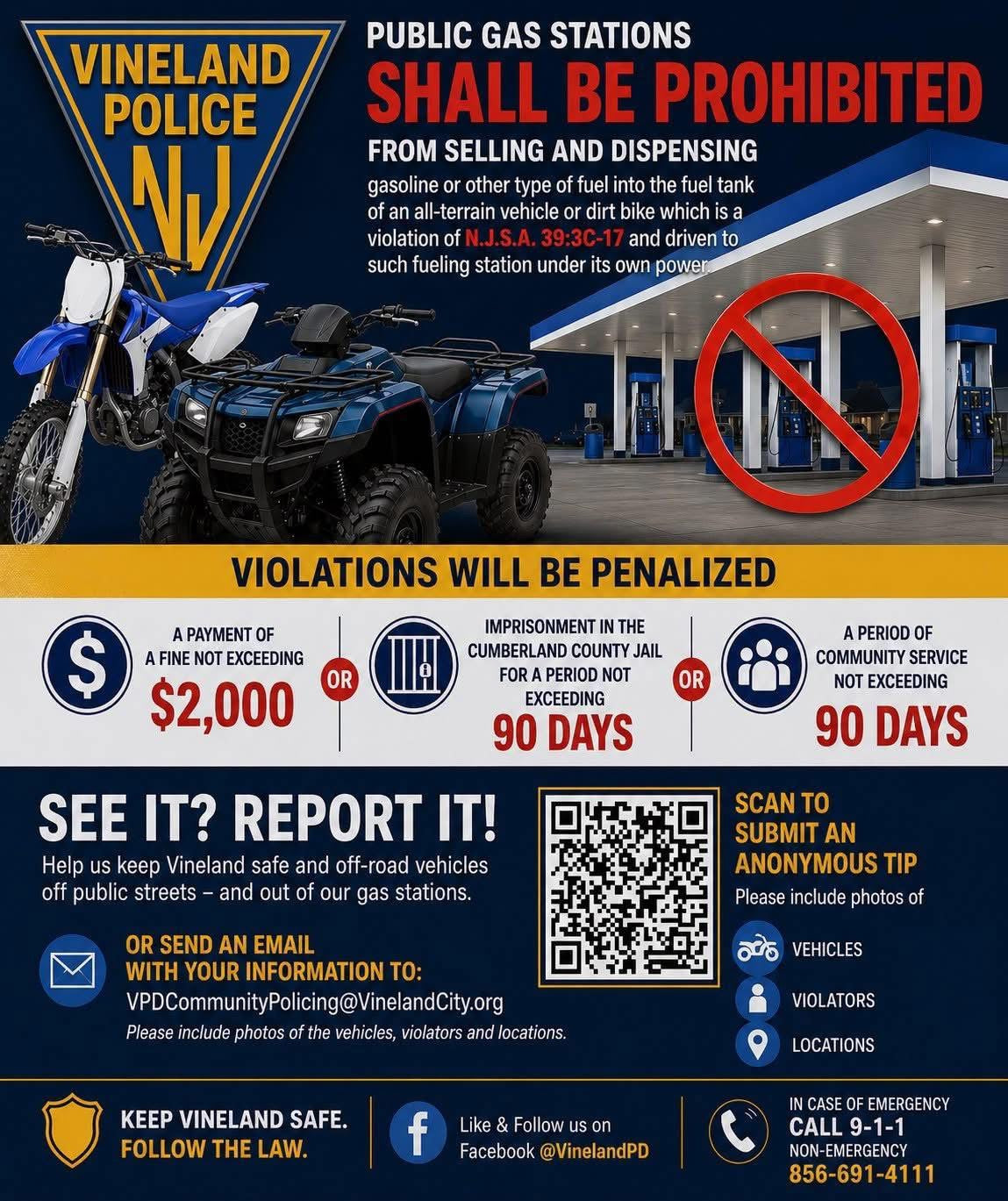
The Vineland Police Department’s recent graphic regarding ATVs and dirt bikes at gas stations raises serious concerns — not only about overreach and profiling, but also about the confusion it creates for businesses and lawful vehicle owners.
There is a massive legal distinction between:
• An unregistered off-road ATV illegally operated on public roads
AND
• A properly titled, registered, insured, and street-legal vehicle from another state.
This matters because many vehicles — including side-by-sides and UTVs — are legally registered for roadway use in states such as Montana. These vehicles may carry:
✅ Valid state-issued license plates
✅ State-issued registrations
✅ Insurance policies
✅ DOT-required equipment
✅ Street-legal classifications under their home state laws
Under long-standing interstate reciprocity principles recognized throughout the United States, a vehicle legally registered in one state is generally permitted to travel through and operate in another state unless there is a very specific law prohibiting that exact conduct.
That is where this Vineland policy becomes extremely problematic.
The law cited in the graphic, N.J.S.A. 39:3C-17, is directed toward certain off-road vehicles being operated unlawfully on public roadways. It does NOT magically transform every out-of-state registered side-by-side into an illegal ATV simply because it “looks” like one.
A Montana-registered street-legal side-by-side is not the same thing as:
• An unregistered ATV
• A dirt bike
• A stolen off-road vehicle
• An illegally operated recreational vehicle
Yet this graphic encourages gas station operators — who are not lawyers, DMV officials, or police officers — to somehow make legal determinations on the spot about complex interstate registration issues.
That creates enormous liability and confusion for businesses.
Are attendants now expected to:
• Investigate registrations?
• Interpret out-of-state motor vehicle laws?
• Determine reciprocity rights?
• Decide whether a vehicle qualifies as “street legal”?
• Refuse service to customers based on appearance alone?
That is not reasonable.
Even worse, this opens the door for selective enforcement and profiling. A legally registered vehicle owner could be publicly embarrassed, denied service, photographed, or reported simply because someone personally dislikes the type of vehicle they drive.
That is dangerous territory.
Nobody is arguing against enforcing reckless driving laws or stopping dangerous behavior. If someone is operating illegally or recklessly, law enforcement already has tools available to address that conduct.
But targeting lawful owners and encouraging anonymous reporting campaigns against anyone fueling a side-by-side creates fear, confusion, and hostility — not public trust.
Policies should target dangerous actions, not appearances.
Because once businesses and citizens are encouraged to act as enforcement agents based on assumptions, everyone’s rights become vulnerable.